How to Upload Your Prescription to Warby Parker
March 2, 2022
How to Read Your Eye Prescription
You've gone to the optometrist, had your eye exam, and now it'southward time to become your prescription. When y'all expect at it, though, you're perplexed—what exercise all these messages and numbers mean? How do they tell yous what kind of spectacles you lot should go?
Not to worry. Eye prescriptions tin can be confusing, simply we'll explicate all of their different parts then you know how to read one. Non just will it help you empathize your eyewear better, it also makes for an extremely practical party play a trick on.
Your Glasses Prescription, Explained
Whether it's on newspaper or digital, your heart prescription probably looks similar a small grid or chart with rows, columns, and cells. Confusingly, the chart incorporates a mix of letter abbreviations, positive and/or negative numbers, and full words.
What do they all mean? Consult our glossary beneath to tackle each element, and so have a look at our example eye prescription chart to utilise your cognition.
Middle Prescription Abbreviations
OD: Your correct eye. OD stands for oculus dexter, which is "correct eye" in Latin. We get the words dextrous and dexterity from the aforementioned root!
OS: Your left eye. OS stands for oculus sinister, which is "left eye" in Latin. We promise there's aught more than morally sinister about your left eye than your right—in this instance, the give-and-take is merely referring to direction.
OU: Both of your eyes. OU stands for oculus uterque, which is "both eyes" in Latin.
NV: Near vision (seeing things close-up).
DV: Altitude vision (seeing things far away).
PD: Pupillary distance. Your pupillary distance is—drumroll—the altitude between your pupils! It'southward a handy measurement that helps align the center of the lens with the center of your pupils so that you have the most accurate vision possible. Your pupillary distance can be measured in a number of ways, including manually or with a specialized device called a pupillometer.
In an ideal world, your middle doctor will include your PD on your prescription every time. But non all doctors practise this. If yours doesn't, you can e'er use our handy tool to measure your pupillary distance online.
SPH: Sphere. In this case, "sphere" means that the correction for nearsightedness or farsightedness is spherical—equally in, equal in all meridians of the eye. You lot'll see numbers listed in the SPH column, and we'll get to those next…
Eye Prescription Calibration
Diopters: Any numbers you encounter in the "Sphere" or "Cyl" column of your eye prescription correspond diopters. A diopter is a unit of measurement, like a gram or an ounce. Instead of measuring mass, however, diopters measure the refractive power of a lens. You'll see larger numbers (more optical power!) if your prescription is higher and lower numbers if your vision doesn't need equally much help from spectacles or contacts.
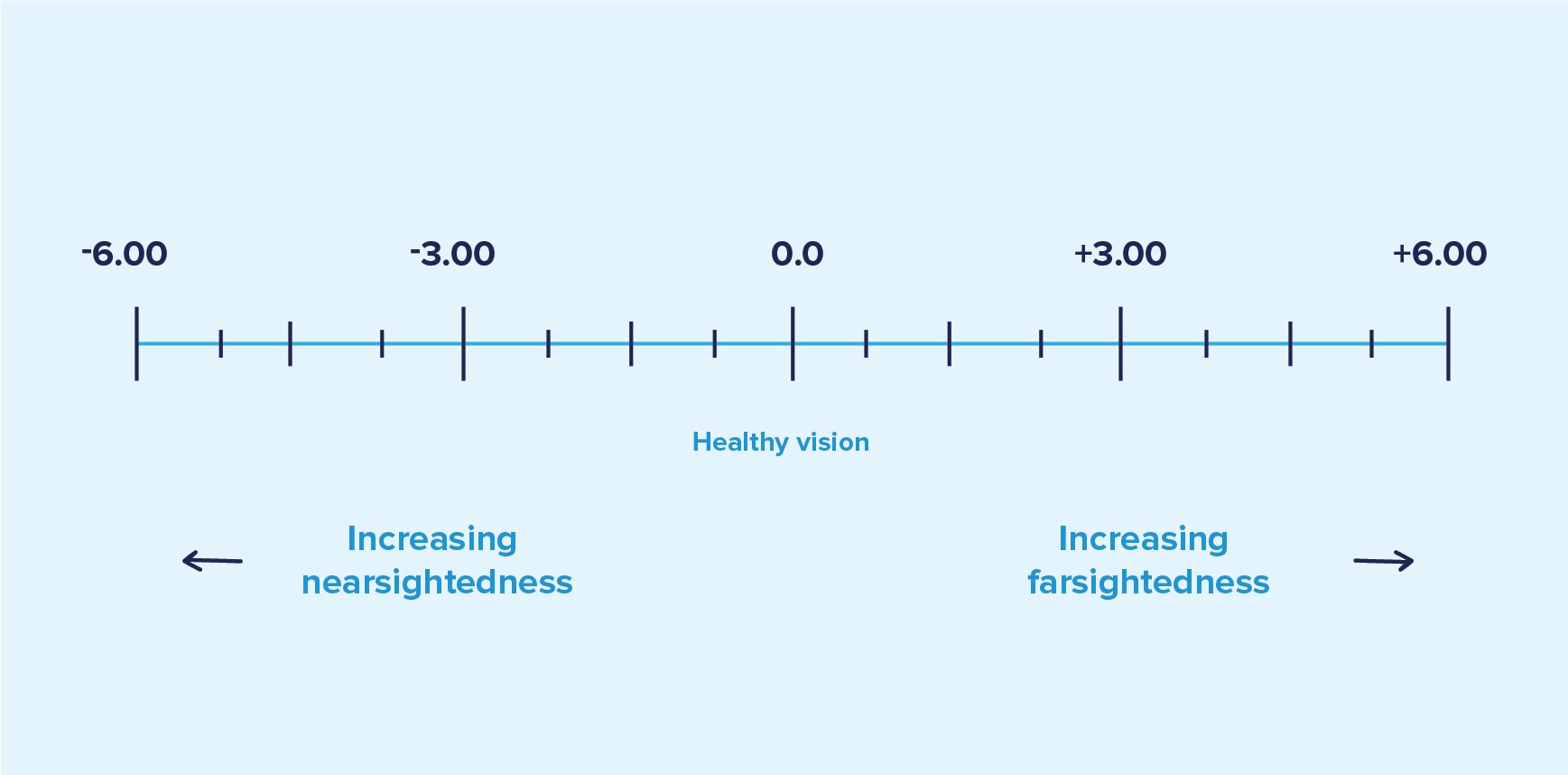
It's important to notation that these numbers proceed in either direction on a number line—they tin be positive or negative, based on the blazon of refractive error in your center. If you don't need spectacles at all, you wouldn't need any optical power from lenses: 0 diopters.
Negative Numbers: If you run across a minus sign in front of a number, that indicates nearsightedness, or myopia. Someone with -iii diopters of nearsightedness, for example, might have trouble reading words on a chalkboard from far away.
Positive Numbers: If you run across a plus sign in front of a number, that indicates diopters that will correct farsightedness, or hyperopia. Someone with +3 diopters of farsightedness, for instance, might struggle to read text that'due south very close to their face.
Other Terms on Your Eye Prescription
Depending on the kinds of lenses y'all need, y'all may run into other terms on your eye prescription, including:
CYL or Cylinder: This term is only relevant to people with astigmatism, and refers to the lens power needed to address it. Astigmatism means your heart'southward cornea or lens is not completely spherical. Therefore, patients with astigmatism need cylindrical rather than spherical vision correction. (If there's no number associated with this term on your prescription, then you lot have no astigmatism to right!)
Axis: Once more, this is for people with astigmatism. It's the number (from 1 to 180) on your prescription that determines the orientation of your astigmatism correction. Axis is measured in degrees, not diopters. The cylinder and the axis always get together—you can't accept one without the other!
Add: Boosted magnification. If you have age-related presbyopia, you may have difficulty reading text shut up, and tin can reserve a section of your glasses lenses for some added magnifying power. It'southward sort of like having reading spectacles built into your regular ones.
Prism: Sometimes, optics don't motion in alignment with one some other, resulting in symptoms such as double vision. (Ane disorder that causes eye misalignment is strabismus, normally known every bit "crossed eyes.")
To account for this condition, your doctor tin can add a prism to your lenses. The prism is placed in a certain position and orientation based on your prescription, which will besides notate the direction of the prism's thickest edge, or base of operations.
- BU: base of operations up
- BD: base of operations downwardly
- BI: base of operations in
- BO: base out
The prism will also accept its own refractive strength, measured in prism diopters.
Expiration Date: Your eye prescription probably won't be the same forever—information technology's important to accept your eyes examined regularly to make sure they're seeing every bit all-time as they possibly can.
Eye prescriptions are unremarkably valid for a year or two earlier they elapse (the exact time menses can vary depending on state laws). After that, yous'll need to renew it by scheduling an center examination.
Eye Prescription Chart Instance
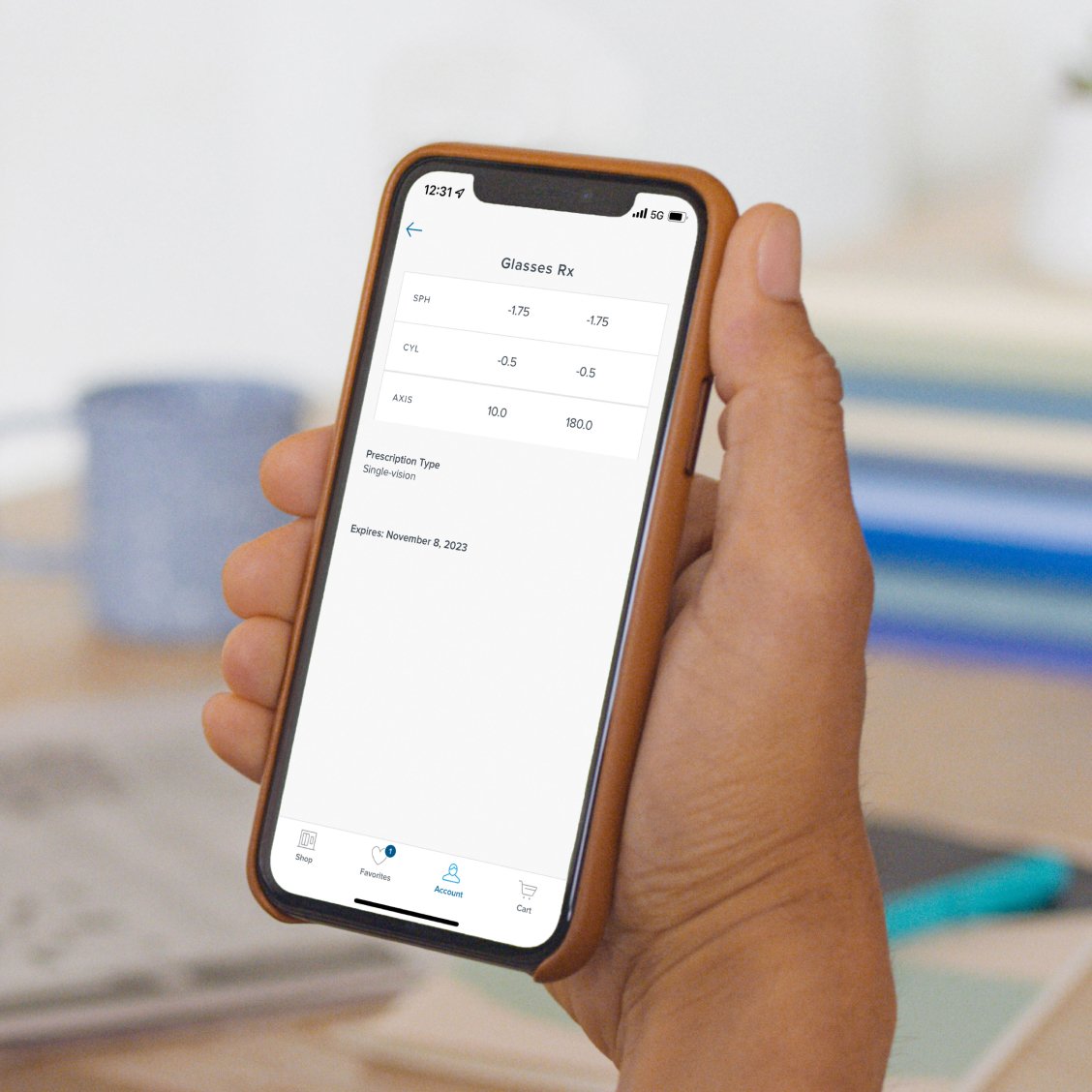
Here are two examples of eye prescriptions, one for someone without astigmatism, and one for someone with it. Can you spot the differences and decode the terms you've learned? If then, yous've learned how to read a glasses prescription similar a pro.

A prescription written for someone with nearsightedness.

A prescription written for someone with nearsightedness and astigmatism.
Is Your Eye Prescription "Bad"?
We get asked this question all the time: "How bad is my eye prescription?" But nosotros don't go in for that kind of negative self-talk! There's no such affair as a "bad" eye prescription—y'all probable mean that you're worried your prescription is unusually strong.
If y'all're interested in cutoffs between moderate and severe kinds of vision problems, we can tell yous that nearsightedness needing a refractive correction of -5 diopters or more is often considered "loftier myopia," whereas a prescription reading +5.25 diopters fits the bill for "high hyperopia." However, these scales can vary from institution to institution.
Another fun fact: people with severe nearsightedness tin experience issues with their nigh vision in addition to their distance vision, and people with severe farsightedness can have their altitude vision affected, too. Vision correction is complex!
The most of import takeaway is that your eyesight isn't "good" or "bad"—information technology just needs a specific corporeality of stylish tech to be equally precipitous as you want it to exist.
Will Your Eye Prescription Change?
Big fluctuations in your vision prescription over time aren't normal and should exist investigated (unless they're the anticipated result of a handling or injury). But minor, gradual changes can certainly occur, especially every bit you lot and your eyes age.
For example, y'all tin await to develop presbyopia every bit you go older (it typically happens to most of us in our forties). When that happens, you might want to get a pair of reading spectacles or incorporate new progressive lenses into your regular frames.
Even if you don't recall your vision is whatsoever unlike and y'all're non experiencing any worrisome symptoms, it's a good idea to get your eyes checked every twelvemonth. Annual eye exams ensure that an optometrist is monitoring your eye health and updating your prescription as needed.
You might be wondering: Is my contact lens prescription the same as my glasses prescription?
Not ever! Your glasses sit at a slight distance abroad from your eyes, whereas contact lenses rest directly on your corneas. That difference in distance means their prescriptions might non match upwards.
Additionally, because contact lenses come with fixed parameters determined by their manufacturers, the md may demand to adapt your contact prescription accordingly. These adjustments tin also differentiate your contact prescription from your spectacles prescription.
Your optometrist as well needs to put boosted information on your contact lens prescription related to fit. That's right—your contacts demand to fit you, just like anything else you wear.
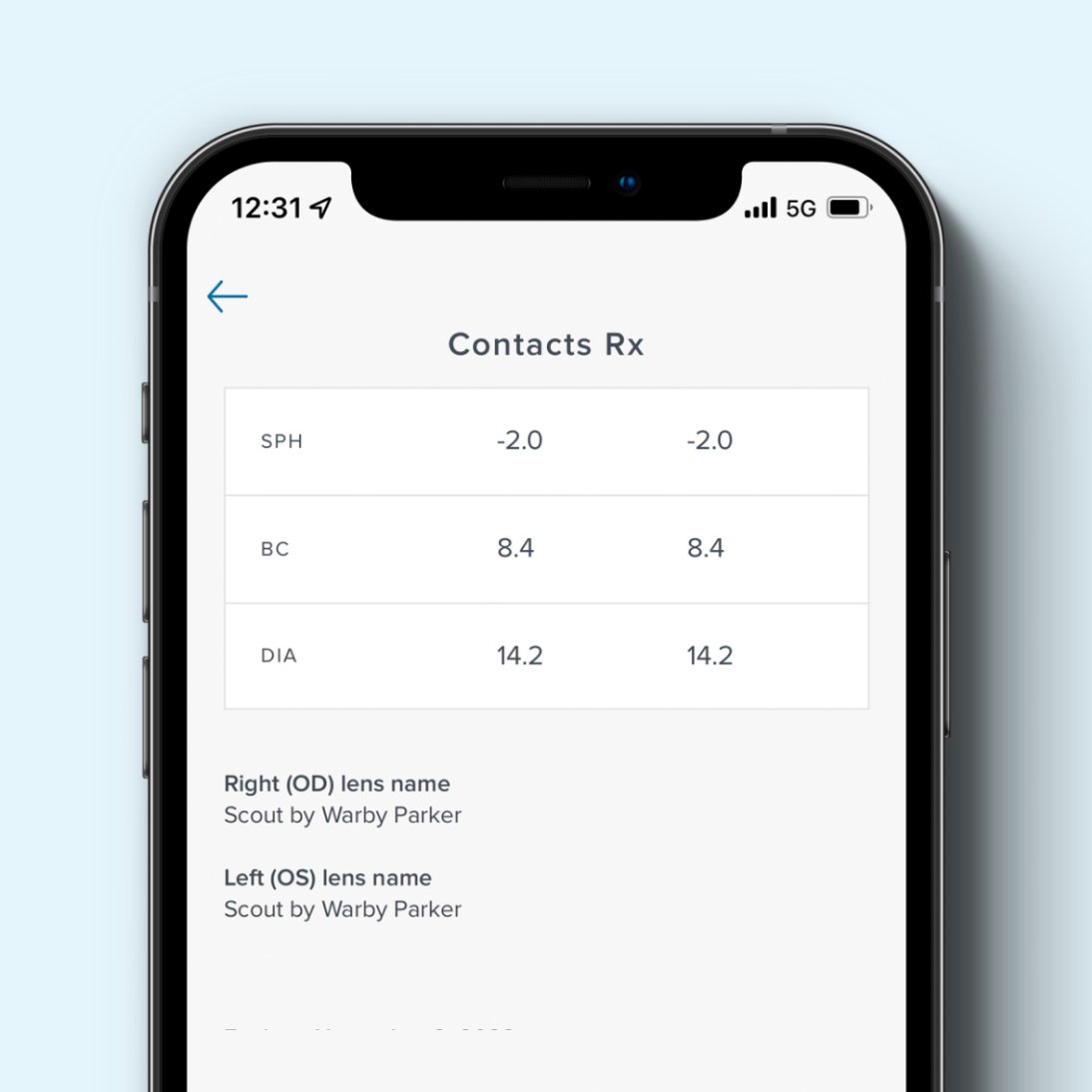
The two measurements you should also see on your contact lens prescription are:
Base Curve (BC): The curvature of your contact lens, which should mold comfortably to the curvature of your natural eye. This measurement in millimeters (mm) ever falls between the numbers 8 and ten.
Diameter (Dia): Just like in regular math, the diameter is the width of a contact lens in millimeters. Most contact lenses are between 13 and 15 mm wide.
And so, if you lot want to habiliment contact lenses in improver to (or instead of) glasses, exist sure to let your eye doctor know when y'all schedule your exam. That style, they'll know to include a contact lens fitting to appraise the fit and vision of the contacts.
Recall: You Have a Correct to Your Eye Prescription
According to the Federal Trade Commission, you are legally entitled to a copy of your eye prescription. Your middle doctor should provide y'all with one subsequently your exam, or whenever yous request it.
You don't take to purchase eyewear from their function to get your eye prescription, and you lot should never have to pay a fee solely to access information technology. We recommend holding on to a copy so that it'south extra-easy to shop for spectacles and contacts online.
Now that you understand your eye prescription perfectly, all that'due south left is to find frames (or contacts) that make you feel fab!
We've got your eyes covered
Store eyeglasses, sunglasses, contacts, and accessories all in i identify—plus enjoy free aircraft and returns.
Shop at present
CATEGORIES
Source: https://www.warbyparker.com/learn/how-to-read-eye-prescription
0 Response to "How to Upload Your Prescription to Warby Parker"
ارسال یک نظر